
Why Hand-Polished Meghalaya Cinnamon Is Superior to Factory-Processed Cinnamon

 |  |
Cinnamon is on
e of the world’s most traded spices — but what many buyers do not realize is that processing methods dramatically influence the quality, aroma, chemistry, and ultimately the value of the spice. Hand-polished cinnamon from Meghalaya represents a distinct and superior category compared to factory-processed cinnamon that dominates global commodity markets.
This article explains the scientific basis for that distinction, why it matters, and how quality can be objectively evaluated.
1. Essential Oil Chemistry Determines Quality
The aroma, flavor, and functional properties of cinnamon come from its volatile compounds — especially cinnamaldehyde, eugenol, and related phenolics.
Multiple analyses of cinnamon essential oils confirm that these compounds dominate quality profiles:
Cinnamaldehyde and eugenol make up the core aroma chemistry of cinnamon bark oils.
These compounds contribute to its fragrance and biological activity, including antimicrobial and antioxidant effects.
How cinnamon is processed — and how the bark is treated mechanically — directly affects the retention of these oils. Abrasion and high-speed drum polishing used in factories can crush oil cells, reducing aroma and flavour potency.

2. Cassia vs True Cinnamon — Composition Matters
“Cassia” refers to several Cinnamomum species (e.g., C. burmannii, C. cassia), which are commonly sold as cinnamon. These species typically have:
A stronger, more pungent profile
Higher cinnamaldehyde percentage than true Ceylon cinnamon (C. verum)
Greater coumarin content, which in excess has safety concerns for long-term or high-dose use.
Understanding species composition is essential because higher oil content and balanced aromatic compounds usually indicate quality, while adulterants and heavy mechanical damage often reduce it sharply.
3. How Processing Affects Chemistry and Aroma
Factory methods typically follow this path:
Dried bark enters rotating abrasive drums
Rough outer cortex is ground off uniformly
Sticks are “polished” mechanically and sometimes sulphur-treated
The result is uniform colour and surface smoothness, but also crushed oil cells and lower volatile compound retention
By contrast, hand-polished processing — as practiced in parts of Meghalaya — involves:
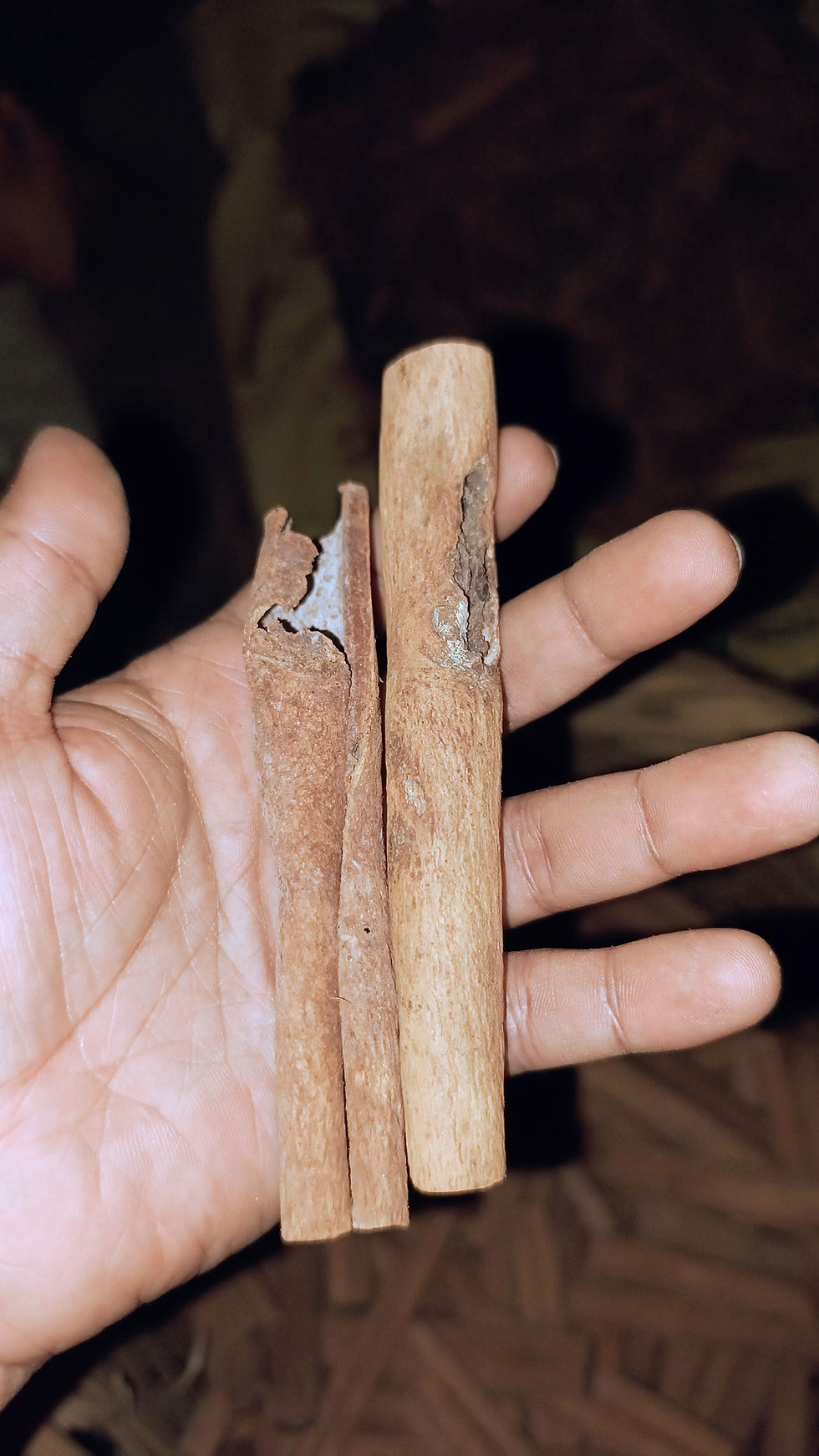
Manual cutting along the bark grain
Selective removal of the outer dirty cortex only
Preservation of inner bark structure and volatile oil reservoirs
This careful manual removal preserves more of the natural aromatic and flavour compounds that make premium cinnamon desirable, even if the sticks look darker or less “uniform” than factory drum-polished ones.
4. Appearance vs Chemistry — Why Visuals Don’t Tell the Whole Story
Many buyers equate light colour and high sheen with quality, but this is often an artifact of sulphur bleaching and mechanical abrasion. Scientifically:
True cinnamon quality is assessed based on volatile oil content and flavor profile, not simply surface colour or uniform appearance.
Higher essential oil and balanced cinnamaldehyde levels correlate with superior sensory and functional quality.
Consequently, visually bright sticks can actually be chemically weaker than darker, hand-trimmed sticks that retain more oil.
5. Scientific Authentication and Quality Standards
Cinnamon quality and classification are subjects of current scientific research:
Modern chromatography and spectroscopic methods are used to distinguish cinnamon species and detect adulteration.
Quality standards (such as essential oil percentage and ash content) are used in official pharmacopoeias to define acceptable cinnamon grades.
This science supports the idea that quality should be measured by chemical composition and aroma retention, not simply by colour, uniformity, or machine polish.

6. Why Hand-Polished Cinnamon Is Superior
Hand-polished cinnamon — such as the traditional product from Meghalaya — typically exhibits:
• Higher aromatic oil retention - Because mechanical damage to the bark surface is minimized, volatile compounds remain intact.
• Richer flavor complexity - Essential oils like cinnamaldehyde and eugenol are preserved, providing greater sensory depth and stability.
• Better chemical integrity - Manual processing avoids sulphur bleaching and harsh abrasion that can degrade aromatic compounds.
• Natural variation that signals authenticity - Minor differences in colour and texture are not defects — they indicate minimal processing and chemical preservation.
7. Buyer Takeaways
For educational buyers evaluating quality:
✔ Do not judge by surface colour alone.
✔ Ask for essential oil content and aroma profile measurements.
✔ Prefer cinnamon with higher volatile compound retention for premium applications.
✔ Understand that manual processing is not inferior — it can be a quality marker, not a cosmetic one.
References
P. Kawatra, Cinnamon: Mystic powers of a minute ingredient, PMC — overview of cassia composition and coumarin content. PMC
J. Blahová et al., Assessment of Coumarin Levels in Ground Cinnamon, PMC — coumarin comparison in cassia vs true cinnamon. PMC
Cinnamon essential oil: Chemical composition and biological activities — major volatile compounds including cinnamaldehyde and eugenol. ResearchGate
Analytical methods for cinnamon authentication — modern scientific differentiation of cinnamon species. sciencedirect.com
Evaluation of different drying methods on the quality … — quality markers including essential oil standards in pharmacopoeias. sciencedirect.com
Cinnamon: A multifaceted medicinal plant, PMC — detailed review of cinnamon’s core constituents and activities. PMC


Comments